Pages

Showing posts with label Women. Show all posts

11.01.2010

Candy and Family: A Halloween Edition


Happy Halloween, bookworms!  Okay, so I'm a little late, but I hope you enjoyed yours as much as I did mine!

A bookish update: I'll be meeting with my reading group this coming Tuesday for our second, and last, discussion of Chris Cleave's Little Bee.  So far, it's been an exceptional title, and I'm really looking forward to finishing it up and discussing my overall views with the ladies in Atlanta.  Sadly, yesterday was the last day of National Reading Group Month, and I'm hoping that my previous post of helpful hints inspired you to organize your own! Furthermore, I'm excited to announce that I've taken the opportunity to create and co-lead a reading group for the Feminist Women's Health Center in Atlanta, Georgia.  The reading group will be tackling, both, fiction and nonfiction titles, with a primary focus on women's issues in literature, and the world around us.  This endeavor will no doubt present a welcome challenge, and provide valuable learning experiences for myself and participants in the community.  Details for those living in the Atlanta area to come!

Now before I move on and present some delicious homemade Halloween treats, let me first offer a little background to put the whole event in perspective...

Every year, around this time, my sweetheart, J, meets his family in their home state of Illinois. They get together with warm embraces, side-splitting stories, delicious food and smiling faces.  Last year, I had the opportunity to join in on such a jaunty occasion (and meet all 40+ members at one time)!  This year  we celebrated J's Granddad's 90th birthday, and I experienced my first inclusion on their annual trip to the university he attended some years ago: Notre Dame.  I may not be a football fan, but the whole experience was almost too sublime to put into words. I enjoyed every minute of it, and can't wait to do it again next year!


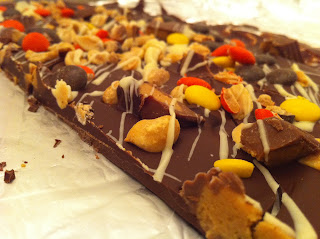
Since we wouldn't be celebrating Halloween at home, and I really wanted to excite some Halloween cheer, I decided to take little goodie bags with homemade candy bark to the family.

I must say, I was mighty proud of the outcome, and thought it cruel not to share with all my lovely readers.  I improvised with this Epicurious recipe, and, that's ok; why shouldn't you be able to customize your own homemade candy bark? So, I figured I'd tempt you with some photos that would  encourage you to make your own!


Note: I made one batch on a baking sheet lined with foil so that I got traditional looking bark.  For the second batch, I used foil cupcake/muffin liners to make candy that resembled peanut butter cups.


Final Product:  


Russian Winter: A Novel
I'd like to take just a moment to share marvelous book I received from a Goodreads GIVEAWAY: Russian Winter. Yes, I won my first giveaway!  It also happened to be a title I was really anticipating.  Don't worry, I'll be sharing real soon.  Promise.


Let me know what you think!  How did you spend your Halloween holiday?  Any spooky reads or recipes you'd like to share?  I'd love to hear!

9.08.2010

Still a Bestseller: Kathryn Stockett's The Help and Why You Should Read It If You Haven't.

The HelpOver a year after its release date I finally received a copy of Kathryn Stockett's The Help. I finished the novel over a week ago and really enjoyed it.  


I mean, I loved it.


I had heard the hype, saw it displayed at every bookstore and realized all my friends had already read it; it was only a matter of time before I did, too.  To be honest, I had no idea what the title The Help alluded to.  It wasn't until I returned from Washington with strict instruction from Q that I must get it, and, subsequently, a visit with my Grandmother who insisted I take her copy because it was something I had to read.  Well, I was sad to see it end.


I'm not here to break down the story line, but to provide a brief overview and then discuss, in the hopes that you've read it, or that this post will encourage you to do so.


The Help focuses on the lives of black maids in the deep Southern state of Mississippi in the 60s, amidst  the growing voices of the Civil Rights Movement.  Stockett provides numerous narrators so that the story flows from several points of view.  First, she provides us with Aibileen, an older woman,  like Minny, her friend, has been working in white households the majority of her life.  Aibileen, unlike Minny, is soft-spoken, and possesses an intense love for the children in the homes she keeps, while grieving the loss of her only son, Treelore.  Minny, on the other hand, has lost more jobs than she can count because of her outspoken nature in the workplace, yet remains submissive and abused by her husband upon returning home most nights.  Obversely, we find Miss Hilly, a snotty twenty-something, who's wealth and status have left her with a husband who is rarely present, two children and a passion for condescension and gossip.  Lastly, we find Skeeter, a privileged white girl who's returned home to her parent's plantation after graduating college, with aspirations to join the ranks of the journalists and writers in New York City.  Skeeter is also one of the only white characters to have a friendly relationship with any of the maids.  When Skeeter is pressed by a New York editor to provide articles of substance, demanding, "Don't waste time on obvious things.  Write about what disturbs you, particularly if it bothers no one else."  After arguments with her friends on the pressing need to equip white homes with separate bathrooms for their help, Skeeter slowly realizes the injustices of a system she has lived in and been apart of for so long.  Aibileen and Skeeter decide to embark on a dangerous task of documenting the accounts of a dozen maids in the white homes they keep.


The novel speaks volumes.  Stockett closely examines the lives of each of the women presented.  The story avoids being convoluted, despite the numerous grave issues the novel exhibits; issues, such as racism in the South, women's submission and violation of male counterparts, and the female status in society during this time period.


The novel deals with, most obviously, the intense racism that was prevalent in this area, at this time period. Public spaces were segregated and never-ending sources of conflict.  Several of the maids are forever changed by violence acted out by white men in their town.  Louvenia, an elderly maid, must work and care for her grandson when he is beaten to the point that he permanently looses his vision for accidentally using a white restroom.  A leading member of the Civil Rights Movement is gunned down in front of his children for participation in the cause.  Stockett examines, through women's stories, the sheer cruelty of mankind in a past not so far off.  The grief is apparent in the dialogue and sends a resounding message of absurdities held as truth.


I admired the way in which Stockett used dialogue and character development to provide unique and honest insight of the individuals presented.  The normalcy of the ideas present, instilled in the characters seems sharply out of place in today's world, and adds a sense of credibility to the story line.  For instance, Minny, a member of the help, looks at a new employer as, "white trash," because Mrs. Foote  doesn't know what's proper in society and eats lunch at the same table as herself.  Minny has a developed system of the way in which she works with the woman whom house she tends.  The details of the way Minny has conceptualized the employer's role, is an emphasis on the ways in which such absurdities are expected and normalized within a society. Furthermore, Skeeter has always loved her help, Constantine, quite possibly more so than her own mother, but has never questioned the quality of the black grocery, compared to her own.  Or the fact that Constantine can't watch after her own children, believing that it's a preference, and not a choice.  


Furthermore, Stockett provides insight into the role of the female during this time.  Minny, a strong-willed and intelligent character, returns home each night to face assaults from her husband.  Minny bears abuse from her employers and her significant other.  The reader witnesses the abuse Minny receives from both her white employers, and her husband, when either is frustrated with their own problems.  Minny is the epitome of an independent woman, in the end, coaching her children to stand up for themselves, and to her employers along the way.  You'll know what I'm talking about if you've read the novel!  On the other hand, the reader witnesses the lives of characters like Miss Anne LeefoltLeefolt are in charge of the maintenance around the home and are certainly expected to procreate.  Many of the white female characters simply sit around their homes all day, attending luncheons to maintain appearances, while their husbands maintain careers.  When Skeeter looks for jobs in a local paper she notes after finding only a few positions for females, "My eyes drift down to HELP WANTED: MALE.  There are at least four columns filled with bank managers, accountants, loan officers, cotton collate operators.  On this side of the page, Percy & Gray, LP, is offering Jr. Stenographers fifty cents more an hour."  


Much of this may seem obvious.  And it is.  But Stockett emphasizes a time unlike anything I've ever known.  Rules and laws of a society that seem so unimaginable, so unthinkable that I am overwhelmed with sadness.  The novel, while entertaining and heartfelt, is so historically political, that it's hard not finding yourself analyzing the wrongs of ideals in the past, and here, in the present.  The novel is thought-provoking and skillfully presented.  I highly recommend The Help, and encourage your thoughts and observations.  
Related Posts Plugin for WordPress, Blogger...